

Finals
How to study for finals in one week

Spend day one finding the score you need on each final and figuring out what's on it. Spend the other six days taking old quizzes, practice tests and problems from scratch with the answers covered, then fixing whatever you missed.
Give most of your hours to the finals that can actually change your grade, not the ones where you're safe. And sleep every night. A week is enough time if you don't waste it rereading.
Day 1: know your numbers before you open a book
Most students start a finals week by opening the first chapter of their hardest class. Don't. Your classes don't need equal time, and you can't split your week well until you know what each final can do to your grade.
Why rereading won't get you through this week
I bet you could recognize your house in a picture instantly. Could you draw it, in color, from memory? Probably not, and you've seen it thousands of times. That's the difference between recognizing something and recalling it.
Rereading your notes trains recognition. The answer is right there, your brain says "yep, I've seen that," and you feel ready. Then the exam hands you a blank problem, and your brain has to figure out what kind of problem it is and how to start it, all on its own. That's recall, and it's a completely different skill.
If you can see the answer, you're not studying.
I'm from Minnesota, so here's how I think about it. Rereading is restarting a car that's already warm. The exam is a cold start at thirty below. With one week left, every hour should be practice at cold starts. See active recall vs rereading for the full version.
Days 2 to 6: practice tests, from scratch
Your old quizzes and midterms are the best practice test you own, because they were written by the person writing your final. Professors love putting the same problem on the final, or the same one with a few words or numbers changed. Their favorites are the ones most of the class missed.
Every practice test you take, you should miss fewer problems than the time before. If you're not, you're checking the answers and moving on instead of learning them.
The week, day by day
You don't have to study every class every day. Low-priority classes get a short review every couple of days so nothing fades, and the rest of your hours go where the points are. The finals study schedule guide shows how to lay it out.
Protect the week
Free tools for this
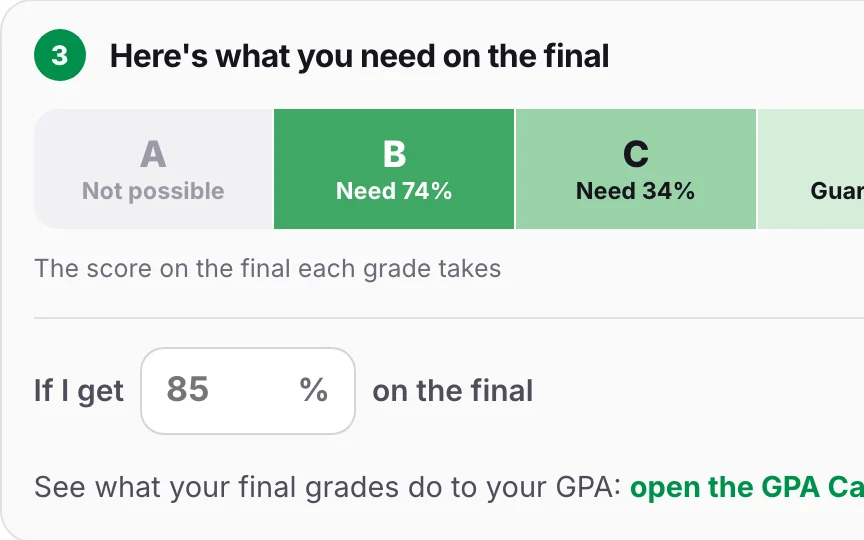
Finals Grade Calculator
The score you need on your final for every letter grade.
Find the score you need →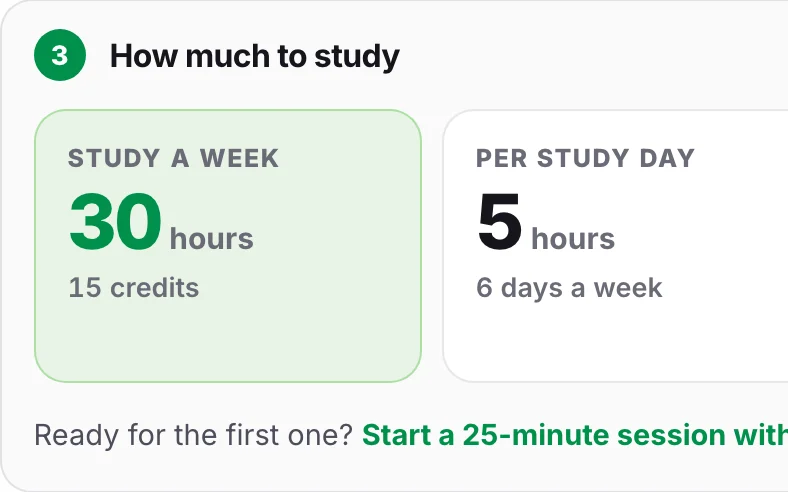
Study Hours Calculator
How many hours to study a week for your classes, and if it fits.
Plan your week →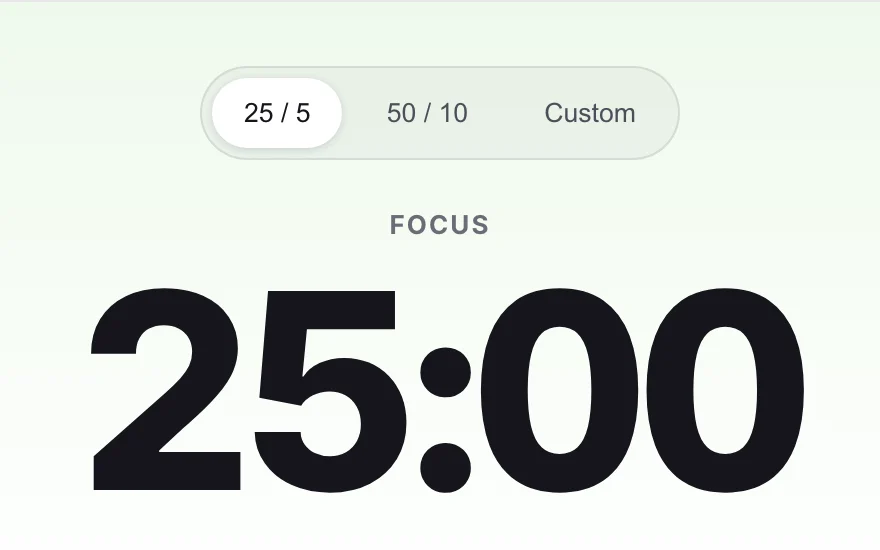
Study Timer
A Pomodoro timer for studying, with study tips that work.
Start a session →Common questions
Is one week enough to study for finals?
Usually, yes, if you spend it on practice tests instead of rereading. Use the first day to find the score you need on each final and what's on it, and put most of your hours into the classes where the final can change your grade.
How many hours a day should I study during finals week?
Two or three focused 50-minute blocks per class you're working on that day, with real breaks, beat a long marathon. The Study Hours Calculator shows how many hours your credits call for in a normal week.
Should I study for every class every day?
No. Rank your classes by what the final can do to your grade. Top-priority classes get the most blocks; classes where your grade is safe get a short review every few days.
What if I'd need more than 100% on the final?
Email your professor this week and ask about extra credit or a curve, then aim for the next grade down. That's still worth studying for.
Keep going
Study with me in Study Hall
Lessons on how to study, live Ask Joe sessions, and a daily plan on your list in the TaskSocial app, with students who keep you honest.
Sources
- Roediger, H. L., & Karpicke, J. D. (2006). Test-enhanced learning: Taking memory tests improves long-term retention. Psychological Science, 17(3), 249–255.
- Adesope, O. O., Trevisan, D. A., & Sundararajan, N. (2017). Rethinking the use of tests: A meta-analysis of practice testing. Review of Educational Research, 87(3), 659–701.
- Dunlosky, J., Rawson, K. A., Marsh, E. J., Nathan, M. J., & Willingham, D. T. (2013). Improving students' learning with effective learning techniques. Psychological Science in the Public Interest, 14(1), 4–58.
- Rohrer, D., & Taylor, K. (2007). The shuffling of mathematics problems improves learning. Instructional Science, 35, 481–498.
- Walker, M. P., & Stickgold, R. (2004). Sleep-dependent learning and memory consolidation. Neuron, 44(1), 121–133.