

Finals
How to make a finals study schedule

Spend the most time on the finals you need to do well on to hold your grade, or to bump it up to the next letter. Spend the least on classes where the grade you want is already secure, where you'd need a really bad score to drop a letter.
Find the score you need in each class first, rank your classes, put your practice test dates on the calendar, then build your study blocks around them.
Step 1: find what each final can do to your grade
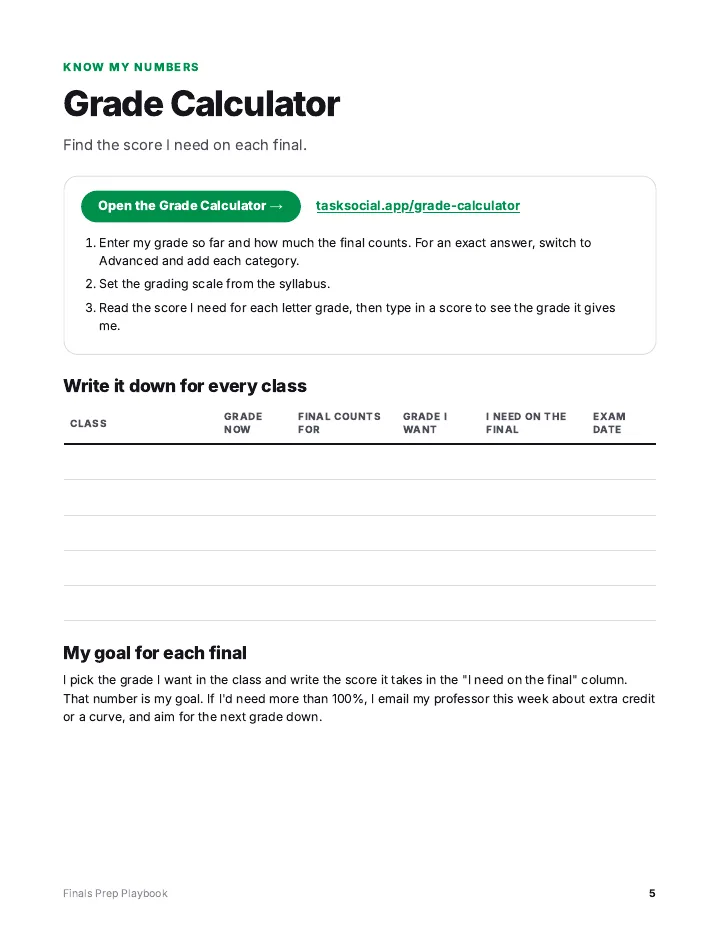
Equal time for every class is the most common finals mistake. Your classes don't need equal time, because your finals don't carry equal risk. Before you schedule anything, put each class into the Finals Grade Calculator and write down the score each letter grade takes.
Here's a made-up semester, so you can see how it plays out:
If a grade would take more than 100% on the final, email your professor this week about extra credit or a curve, and plan for the next grade down.
Step 2: rank your classes
Rate how ready you feel for each topic, too, from 1 to 5. Your time goes to the 1s, 2s and 3s that are likely to be on the final. A 5 only needs a quick check every few days.
Step 3: build the calendar, practice tests first
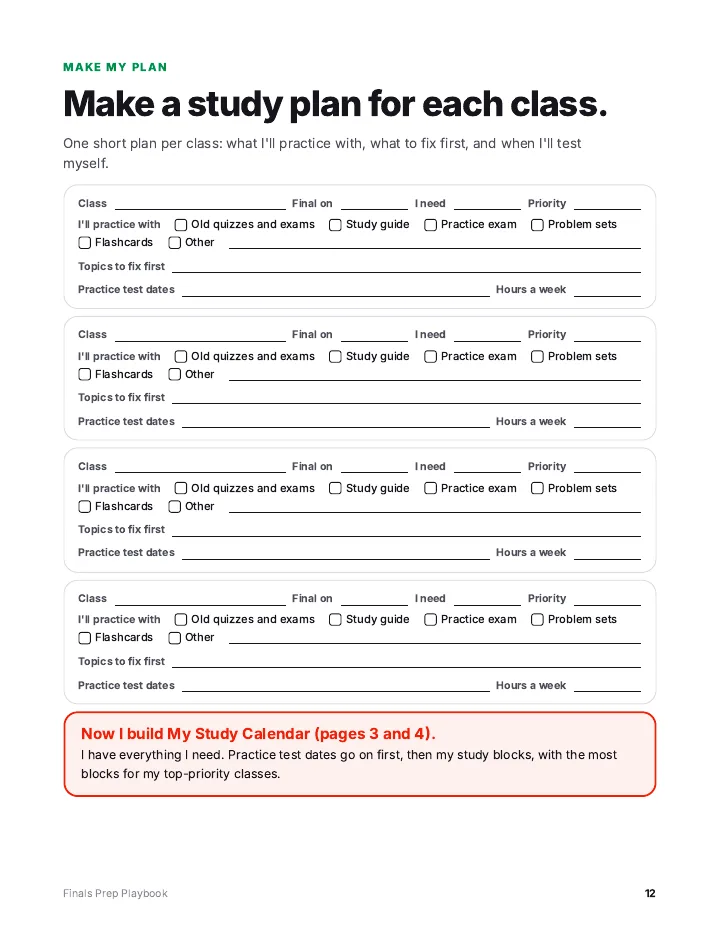
You don't have to study for every class every day. Mixing classes and topics within a day is good for you, though: the exam won't tell you which chapter a question is from, so your practice shouldn't either.
Step 4: check it every Sunday
Once a week, look at where you are. Have you taken the practice tests you planned? Can you do every problem on every old quiz? If you're behind, move blocks now, not the night before. A schedule you adjust beats a perfect one you abandon.
Free tools for this
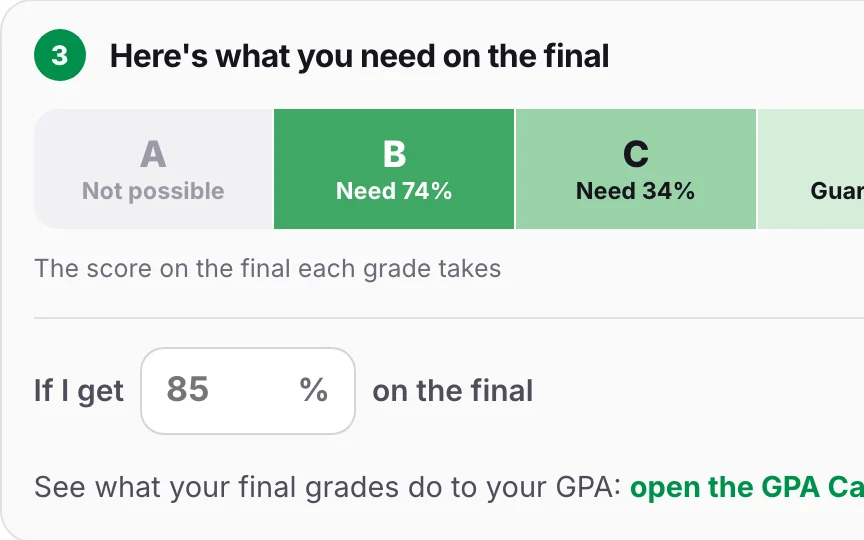
Finals Grade Calculator
The score you need on your final for every letter grade.
Find the score you need →Finals Prep Playbook
A study calendar, the score you need on each final and the methods that work.
Get the playbook →
Study Hours Calculator
How many hours to study a week for your classes, and if it fits.
Plan your week →Common questions
How do I make a study schedule for finals?
Find the score you need on each final, rank your classes by how much the final can change your grade, put the exams and practice test dates on a calendar, then fill in study blocks with the most going to your top-priority classes.
How many weeks before finals should I start studying?
Two to three weeks is ideal: enough time to take an easy, medium and hard practice final for each class and fix what you miss. If you have less, see finals in one week.
Should I study for my hardest class the most?
Not always. Study most for the classes where the final can change your letter grade. A hard class where your grade is safe needs less time than an easier one where you're a point from the line.
How long should each study block be?
About 50 minutes on one class, then a 10-minute break away from a screen. The Study Timer runs 50/10 and 25/5 sessions.
Keep going
Study with me in Study Hall
Lessons on how to study, live Ask Joe sessions, and a daily plan on your list in the TaskSocial app, with students who keep you honest.
Sources
- Cepeda, N. J., Pashler, H., Vul, E., Wixted, J. T., & Rohrer, D. (2006). Distributed practice in verbal recall tasks: A review and quantitative synthesis. Psychological Bulletin, 132(3), 354–380.
- Rohrer, D., & Taylor, K. (2007). The shuffling of mathematics problems improves learning. Instructional Science, 35, 481–498.
- Adesope, O. O., Trevisan, D. A., & Sundararajan, N. (2017). Rethinking the use of tests: A meta-analysis of practice testing. Review of Educational Research, 87(3), 659–701.