Study Hall
Finals PrepPLAYBOOK
My plan for November and December
My plan
Table of contents
| 1 | My Study Calendar | 3 |
| 2 | Grade Calculator | 5 |
| 3 | Rank my classes | 6 |
| 4 | Figure out what's on each final | 7 |
| 5 | My topic lists | 8 |
| 6 | Make a study plan for each class | 12 |
| 7 | Re-take my old quizzes and exams | 13 |
| 8 | Use AI to prep | 14 |
| 9 | Build My Study Calendar | 15 |
| 10 | Study with the three best methods | 16 |
| 11 | My phone is the villain | 17 |
| 12 | Sleep, focus and energy | 18 |
| 13 | Week by week: where I should be | 19 |
| 14 | The night before and exam day | 20 |
My Study Calendar Nov 15 – Dec 5
My Study Calendar Dec 6 – 26
Know my numbers
Grade Calculator
Find the score I need on each final.
- Enter my grade so far and how much the final counts. For an exact answer, switch to Advanced and add each category.
- Set the grading scale from the syllabus.
- Read the score I need for each letter grade, then type in a score to see the grade it gives me.
Write it down for every class
| Class | Grade now | Final counts for | Grade I want | I need on the final | Exam date |
|---|---|---|---|---|---|
My goal for each final
I pick the grade I want in the class and write the score it takes in the "I need on the final" column. That number is my goal. If I'd need more than 100%, I email my professor this week about extra credit or a curve, and aim for the next grade down.
Know my numbers
Rank my classes.
My classes don't need equal time. I give each one a priority, and my study hours follow it.
| Class | I need on the final | How ready I feel (1–5) | Priority |
|---|---|---|---|
How I choose
I need a high score and I don't feel ready. These get the most study blocks every week.
I need a solid score and I mostly know it. I still need to study, but not as much.
My grade is safe with a modest score. A few review sessions, then my hours go elsewhere.
These are the same three priorities My Study Calendar uses. Top-priority classes get the most blocks.
Know the exam
Figure out what's on each final.
Most professors say far more about the final than students notice. I spend one evening collecting the clues for each class, then build a topic list.
Collect the clues
- The syllabus: is the final cumulative, or only material since the midterm?
- Any study guide, review sheet or review session (go to the session).
- Past quizzes, exams and homework: the same kinds of questions come back.
- Lecture slides: anything repeated, starred, or said twice out loud.
- Practice exams from the course site, the textbook, or the department.
- Office hours or an email to the professor or TA.
What I ask my professor or TA
- "Is the final cumulative, or weighted toward the last unit?"
- "Which topics will carry the most points?"
- "Will the format be like the midterm?"
- "Are there practice problems you'd recommend?"
Asking in office hours also puts my face to my name, which never hurts at grading time.
Build my topic lists
The next four pages are my topic lists, one page per class. For each class I list every topic, mark whether it's likely on the final, and rate how ready I feel from 1 to 5, the same scale I used to rank my classes.
My time goes to the 1s, 2s and 3s that are likely on the final. A 5 only needs a quick check every few days.
Know the exam · class 1 of 4
My topic list
| Topic | Likely on the final? | How ready I feel (1–5) |
|---|---|---|
One page per class. More than four classes? Print this page again for each one.
Know the exam · class 2 of 4
My topic list
| Topic | Likely on the final? | How ready I feel (1–5) |
|---|---|---|
One page per class. More than four classes? Print this page again for each one.
Know the exam · class 3 of 4
My topic list
| Topic | Likely on the final? | How ready I feel (1–5) |
|---|---|---|
One page per class. More than four classes? Print this page again for each one.
Know the exam · class 4 of 4
My topic list
| Topic | Likely on the final? | How ready I feel (1–5) |
|---|---|---|
One page per class. More than four classes? Print this page again for each one.
Make my plan
Make a study plan for each class.
One short plan per class: what I'll practice with, what to fix first, and when I'll test myself.
Practice
Re-take my old quizzes and exams.
My graded quizzes and exams are the best practice test I own: they're written by the person writing my final. Most students glance at the answers and nod. I cover the answers and take them again.
How I do it
- Cover every answer. Sticky notes, a sheet of paper, or a reprint with the answers blanked out. My marks and the professor's comments get covered too.
- Take it cold, timed, without notes. I treat it like the real thing. Guessing and getting it wrong teaches me more than reading the right answer.
- Grade myself against the original, honestly.
- Sort every miss into one of three piles (below). Each pile has a different fix.
- Redo the misses in two days, again with answers covered. A question isn't done until I get it right twice on different days.
I re-learn the idea from my notes or the book, then make a flashcard or two that test it.
I write the mistake down in one line ("dropped the negative sign") and read that list before the exam.
I practice underlining what the question actually asks before I start answering.
No old quizzes or exams for a class?
I make my own: homework problems, end-of-chapter questions and study-guide items become a practice test, or AI builds one from my notes (page 14). Then I take it the same way: covered, timed, graded.
Practice
Use AI to prep.
If the AI is doing the thinking, I'm not studying. I use it to test me, explain my mistakes and make practice material.
First: one conversation per class
- One class, one conversation. I keep each class's finals prep in its own conversation and always come back to that same one. It only helps me prepare for that one final.
- I give it everything for that class: the syllabus, the study guide, practice problems, the book or the chapters that matter, my notes, and my old quizzes and exams. Anything I can upload quickly.
Then: prompts worth copying
Quiz me, one question at a time
Build three practice finals: easy, medium, hard
I take them in order: the easy one first, then the medium, then the hard one, each timed and without notes.
Explain what I got wrong
Find what's likely on the final
Watch out: AI gets facts wrong, so I check against my notes and the book. Reading an AI summary is just rereading. I follow my school's and my professor's AI rules.
Make my plan
Build My Study Calendar.
For each class, my calendar has
I write my classes across the top and check each box once it's on the calendar.
| On My Study Calendar | ||||
|---|---|---|---|---|
| The final, project or paper, on its date | ||||
| My study blocks: how many, on which days | ||||
| The days I review old material | ||||
| The days I do active recall on old quizzes, problem sets and tests | ||||
| My easy practice test | ||||
| My medium practice test | ||||
| My hard practice test |
Top-priority classes get the most study blocks. Practice test dates go on first, then everything else around them.
In every study session, wherever I can
- Spaced repetition: recall it today, tomorrow, in 3 days, in a week.
- Active recall: pull it out of my head without looking.
- Interleaving: mix problem sets, topics and classes.
I don't have to write these on the calendar. Page 16 shows how each one works.
How I study
Study with the three best methods.
Rereading and highlighting feel productive, but they mostly build familiarity, not memory. These three make my brain do the work, and that's what makes it stick.
Spaced repetition: recall it right before I forget
One long session fades fast. Short recalls spread over minutes, then days, stick, because each one comes just as the memory starts to slip.
- Learn a topic today.
- Recall it several times over a period of minutes, in that same session.
- Recall it again tomorrow, then in 3 days, then in a week. Each one is short: 10 to 15 minutes.
- Note on My Study Calendar to use spaced repetition.
Active recall: pull it out of my head
Pulling an answer out of my head, without looking, is what builds memory.
It is
- Flashcards, where I can't see the back side
- Covering up the answer and re-solving it on a blank page
- Taking a practice quiz or a practice test (page 13)
- Covering a section of the book and reciting it from memory
- Explaining it to a friend
It is not
- Rereading the book
- Rewriting or recopying my notes
- Highlighting
- Looking at the answer and nodding
Interleaving: mix it up
On the exam, nobody says which chapter a question comes from. So I don't study everything in the order the book or the class presented it.
It is
- Bouncing back and forth between different problem sets, quizzes, midterms and practice tests
- Mixing chapters and topics, so I can't predict what's next
- Switching between classes, if I want to
It is not
- Going problem by problem, in sequence, through the book
- Working through my notes from the first page to the last
Protect my focus
My phone is the villain.
It is built to take my attention, and every minute it takes comes out of my grade. Right now it is trying to help me get bad grades on my finals. I have to beat it.
When I study, my phone is
Left behind
In my room, in another room, anywhere I'd have to get up and walk to.
Powered down and zipped away
Off, not silenced, and zipped into a pocket of my backpack.
In Focus Mode
Focus Mode in the TaskSocial app keeps my apps locked until my study task is done.
Why it has to be this strict
- A "quick check" is rarely quick, and it takes minutes more to get back into what I was doing.
- A phone on the desk pulls at my attention even face down and silent.
- Two real hours with no phone beat five hours with it next to me.
Focus Mode in TaskSocial
I pick the apps that distract me, start a study task, and they stay blocked until I check it off. My friends can see when I go in, and if I quit early. Free on iPhone: tasksocial.app
My rule
Take care of myself
Sleep, focus and energy
Two students can study the same hours and remember very different amounts. A lot of the difference is how rested, focused and fueled they were while doing it. None of this takes extra time.
Sleep
- Sleep is when what I studied gets stored. Cutting it to study more works against me.
- I pick a bedtime and a wake-up time and keep them, weekends too.
- Lights and screens get dimmer in the last hour before bed.
- No all-nighters. A tired brain reads the question wrong.
Focus
- One class and one method per 50-minute block, then a real 10-minute break, away from a screen.
- Two or three blocks a day beat an all-day "study session".
- My phone is dealt with before I start (page 17).
Energy
- Real meals at regular times, and water on my desk.
- Outside in daylight soon after I wake up.
- Breaks on my feet: walk, stretch, get air.
- Coffee is fine in the morning. I stop early in the afternoon so it doesn't cost me sleep.
My finals routine
| Every day I will | My plan |
|---|---|
| Be in bed by | |
| Wake up at | |
| Get outside at |
Stay on track
Week by week: where I should be.
I check myself against this each Sunday. If I'm behind, I move blocks on My Study Calendar now, not the night before.
- I know the score I need on every final (page 5).
- My classes are ranked and my topic lists are done (pages 6 to 11).
- I've started re-taking old quizzes and exams.
- I've asked about the hardest material from November in office hours.
- Before I leave: one practice session for every class.
- Thanksgiving Day is a day off. I take it.
- Friday to Sunday: one short block a day, top-priority class first, so nothing fades.
- Projects and papers: a full draft or outline exists by Sunday.
- I've taken my easy practice final for each class (page 14).
- I can do every question on every old quiz and exam.
- I understand the hard material from November, or I've booked help for it.
- Projects and papers are finished or one sitting away.
- I've taken my medium practice final for each class, timed.
- Mixed problem sets on my weakest topics.
- My sleep schedule is set and I'm keeping it.
- I've taken my hard practice final before each exam.
- Before each exam, one more look at the questions that gave me trouble.
- After each exam, a real break, then on to the next one.
Exam day
The night before and exam day
The work is done by now. I keep the last 24 hours simple.
The night before
I go to bed at a reasonable time. Walking in well rested is worth more than one more late hour.
Exam day
I do my normal routine. If I eat breakfast, I eat breakfast. If I don't, I don't. Nothing new today.
Right before the exam
I look one more time at the questions I had a tough time with, especially the ones I missed on a practice exam. They're the ones most worth having fresh.
During the exam
- I don't spend too long on a problem I can't get. I mark it and move on to the next one.
- The hardest problems aren't always at the end. Easy problems are often left for last, and students miss them only because they never got there.
- Easier problems can unlock harder ones. Working one can trigger the memory I needed for the one I was stuck on. Then I go back and solve it.
After each exam
I don't replay it. I take a real break, then turn to the next class on My Study Calendar. One down.

Study Hall
with Joe Sweeney · @tasksocialapp
I help college students perform better in school and live better lives, without doing more work.
Five ways I'll help you
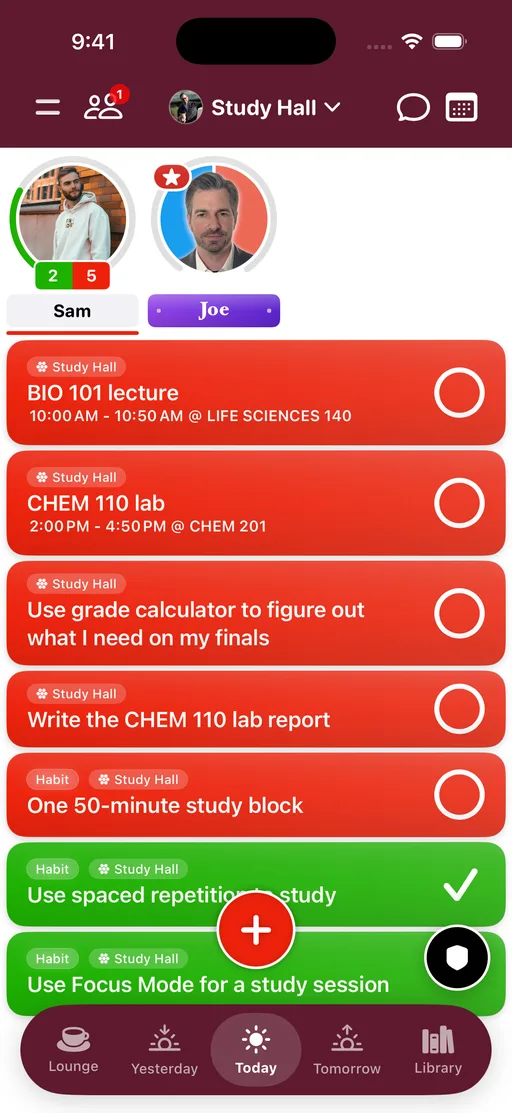
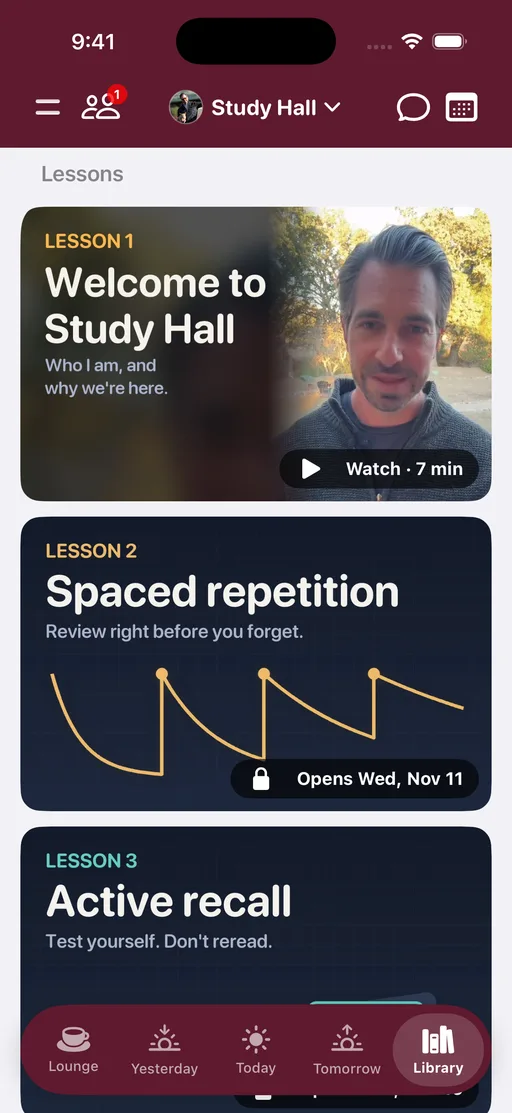
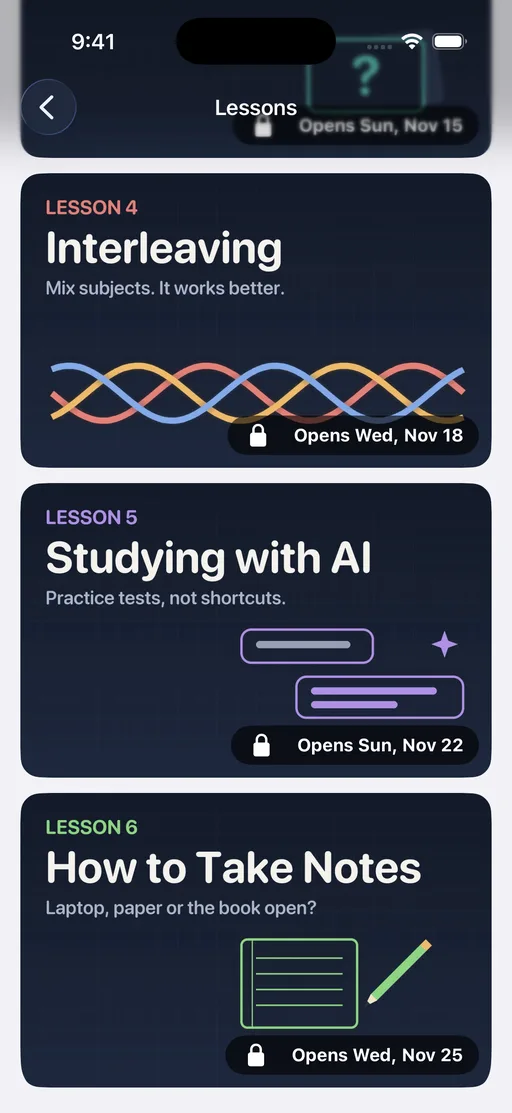
- Lessons that go deeper. The habits, routines and study methods top students use.
- Live Ask Me Anything. Ask me about college, studying or life, live in the app.
- Personal answers. Post a question and I answer it myself.
- A daily plan on your list. Real habits and tasks land on your Today list.
- Students who keep you honest. They see your list, you see theirs.